 Katherine Martine | Wine Business Monthly
As sustainability becomes a more important value to today’s consumer, there are many ways wineries can lean into this—such as using lightweight glass, natural cork, wine in keg or even reusable wine bottles—and additionally the companies behind these solutions are also leaning into sustainability, making strides in more eco-friendly operations.
Napa Green held a workshop, ‘Green Your Supply Chain – Sustainable Packaging Workshop at Charles Krug winery in St. Helena on Thursday.
Organizations and companies who presented their solutions and findings at the workshop included Verallia, the Natural Cork Council, Cork Supply and Crealis, Free Flow Wines, Treasury Americas, Revino, Keystone Capsules, North Bay Zero Waste Collective and Napa Recycling.
For glass manufacturer Verallia, reducing its environmental impact is a big initiative—they aim to reach a net zero carbon target by 2040. According to their website, “Verallia’s Net Zero trajectory, validated by the SBTi, commits the Group to reducing CO2 emissions by 90% for scopes 1 and 2 by 2040, with 10% offsetting. For scope 3, the target is a 90% reduction by 2050.”
To reduce these CO2 emissions across these scopes, they’re concentrating on:
Andrew Thompson, sales director at Verallia USA, also said the company is working to develop low carbon furnaces and reduce water usage.
“Our purpose is we want to reimagine glass for sustainability…We want to redefine how glass is produced, reused and recycled to make it one of the world’s most sustainable packaging materials,” Thompson said.
In terms of the company’s own lightweight glass offerings they have several like LionGlass—developed through a partnership with Penn State—which melts at temperatures up to 400 degrees Celsius, lower than conventional glass, and eliminates direct CO2 emissions by removing carbonates from the glass making formula, and the ecova and air line.
A highlight from the Crealis talk with Frederic Catteau, General Manager, VP Crealis USA, was the Virtuo cap—announced last year—made from pure tin 100% recycled. The capsule has a 98.8% recyclability rate and has a 61% reduction in CO2. As a company, Crealis is also committed to reducing scope 1, 2 and 3 Green House Gas emissions.
Free Flow Wines discussed the green benefits of wine in steel keg, which include being 100% reusable/ recyclable (not all processing plants recycle plastic kegs, according to Rob Perman, president and COO at Free Flow Wines), low carbon footprint and manufactured from recyclable material.
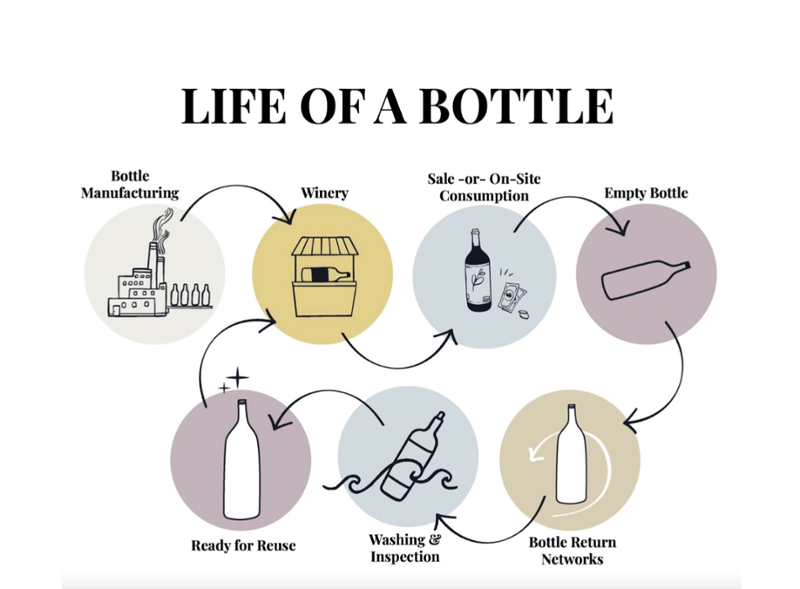
To promote a more circular economy, Revino, an Oregon based company that aims to revive the reusable glass bottle ecosystem, shared the advantages of using reusable glass bottles. Firstly, it’s an eco-friendly move.
Adam Rack, co-founder and sustainability steward at Revino, noted that “69% of glass is landfilled in the US.” And bottles sent to landfills in the US annually amounts to ~3.6 billion, yet glass can be recycled or reused. Reuse has marketing, value boosting and supply chain resilience benefits. As the paradigm shifts on how we think of reuse, Rack made note of the green and sustainable marketing advantage that reuse brings; 84% of Americans have interest in buying products in reusables. And, Americans are willing to pay a 12% premium for reusable packaging, he said.
For the program, bottles can be collected from the tasting room, distributor partnerships or collections from deposit return systems—some wineries do a managed pool system where they work together on reuse. Afterwards, bottles are washed, de-labled and de-capsuled, probed for chips or cracks, then stacked and readied for new use.
Brooks winery in Amity, Ore. was among some of the first wineries to work with Revino on reuse. The 2023 Janus Pinot Noir was Brooks’ first wine in reused bottles, and when it was announced in January 2025, guests could use Brooks’ Green Loyalty Points to support sustainability efforts while earning perks at the winery.
“With Revino, we’re taking another step toward reducing our environmental footprint and giving our customers a simple way to join us in supporting sustainability,” Janie Brooks Heuck, Managing Director of Brooks Wine, said in the press release about the partnership.
Another wine company to make sustainable strides is Treasury Americas, which has been exploring light weight glass and other green projects.
Speakers Luke Magnini, regional director of hospitality at Treasury Americas, and Caitlin Hodes, sustainability manager at Treasury Americas, cited from research that two consumer studies found support for moderate lightweighting of heavy bottles and benchmarking found that TWE luxury bottles are overweight.
They made a 4% reduction in glass weight for DAOU Sauvignon Blanc, a 15% reduction in eight Frank Family SKUs, a 9% reduction across four Stag’s Leap SKUs and a 20% reduction in five Sterling SKUs. For their BOLD brands, changes anywhere from 76g to 147g reduction per bottle were made, a 14% to 27% reduction.
This lightweighting across different SKUs led to an overall reduction of about two thousand tons. “We did prioritize some of the heaviest hitters, those would be more of the luxury products that oftentimes weigh over 1,000 grams,” Hodes shared.
Not only is Treasury using lightweight glass, but they also do keg wine at Sterling, which was launched in conjunction with its reopening in 2023.
From a hospitality standpoint, there were some key findings from this launch:
“Starting with keg wine allows Sterling to lead conversations about innovation, stewardship and modern luxury from the outset, eliminating oxidation at the most critical tasting moment.
Wine on tap guarantees no oxygen exposure, ensuring every guest’s first taste tastes exactly as the winemaker intended.
Steel kegs maintain wine integrity regardless of pour pace, solving a long-standing tasting room challenge of uneven freshness.
Zero-waste packaging aligns with evolving guest expectations.
Reusable steel kegs eliminate packaging waste entirely. nothing to recycle, discard, or manage. A welcome answer to growing consumer demand for sustainable formats.”
Treasury Americas is also working on a pilot program with their Etude brand for glass bottle reuse with Revino.
To start, they are introducing the reuse concept in the tasting room at Etude on a smaller scale and sending those bottles back and analyzing how they hold up against their quality processes.
“It’s been exciting to get that enthusiasm from the Etude team and to hear from folks in the tasting room that it’s something consumers are really excited to hear about,” Hodes said. “We’re excited that we’re getting some initial traction because as a large company we have a lot of different stakeholders to bring along in this journey.” She added the team sees a lot of potential for this could be marketed over time.